AI receptionists
AI Answering Service vs Live Answering Service for Contractors
Short answer
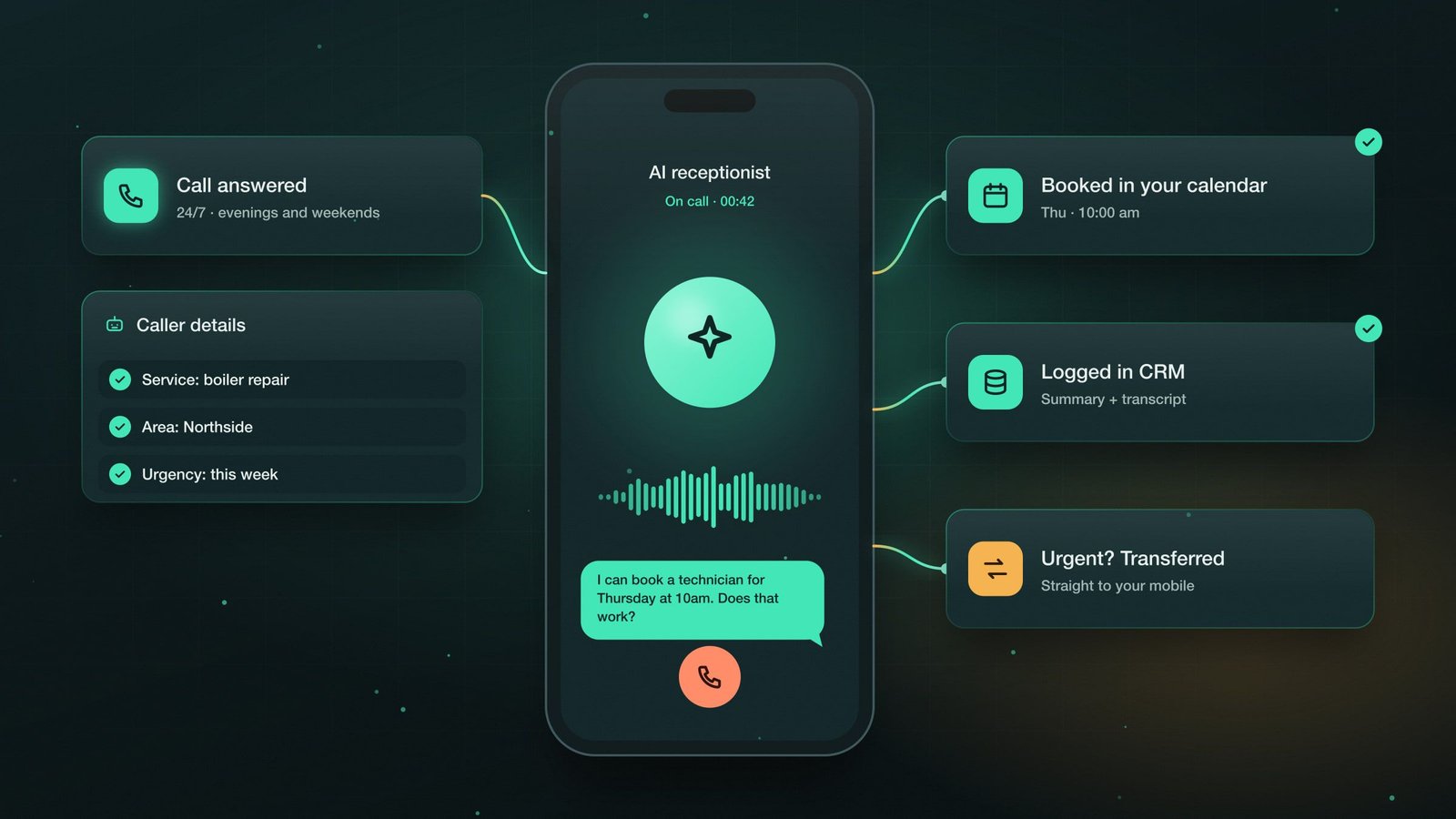
A live answering service uses people to take messages and sometimes book jobs. An AI answering service uses a voice agent that answers every call instantly, books straight into your calendar and logs each call in your CRM. For most contractors, AI handles routine calls and after-hours overflow better, while a person is still best for complaints and complex sales calls.
If you run an HVAC, plumbing or roofing company, you can’t answer every call yourself. The usual fix is an answering service. Today you have two very different options: a live answering service, where people answer your calls, or an AI answering service, where a voice agent does.
Here’s a plain comparison, so you can pick what fits your business.
What does a live answering service do?
A live answering service is a call center that answers your phone in your company’s name. Depending on the plan, the agent:
- takes a message and sends it to you by text or email;
- follows a script to collect the caller’s name, address and problem;
- sometimes books appointments, if you give them access to your calendar;
- sometimes forwards urgent calls to your on-call tech.
The agents answer calls for many businesses, so they usually know a little about your trade, but not much about your company.
What does an AI answering service do?
An AI answering service, also called an AI receptionist, is a voice agent trained on your business. It answers in a natural voice and follows the rules you set. A good setup:
- answers every call instantly, day and night, including several at once;
- asks your qualifying questions (job type, address, urgency);
- books the job straight into your calendar and texts the customer a confirmation;
- sends urgent calls, like a burst pipe or no heat, to your on-call tech;
- logs every call with a summary in your CRM, and texts you the details.
It doesn’t get tired at 2am, it doesn’t put callers on hold, and it gives the same answer every time.
How do they compare?
| What you need | Live answering service | AI answering service |
|---|---|---|
| Answers at night and on weekends | Yes, on most plans | Yes, always |
| Answers several calls at once | Depends on staffing | Yes |
| Books jobs into your calendar | Sometimes | Yes, when connected |
| Knows your services and prices | Basic script | Trained on your FAQ |
| Logs calls in your CRM | Usually not | Yes, with a summary |
| Handles upset or complex callers | Better | Should hand these to a person |
| Consistent answers | Varies by agent | Same every time |
When is a live answering service the better choice?
A person still does some things better:
- Complaints and upset customers. Empathy and judgment matter here.
- Complex sales conversations. A large remodel or a commercial contract needs a real conversation.
- Callers who insist on a human. Some will always prefer a person.
If most of your calls are like this, a live service, or your own office staff, may still be the right answer.
When is an AI answering service the better choice?
For most home-service companies, the bulk of calls are routine: “Can you come out?”, “Do you service my area?”, “How much is a service call?” AI handles those well, and it’s a big step up when:
- Calls come in after hours. Emergencies and new customers don’t wait for 8am.
- Calls spike. A heat wave, a freeze or a storm can flood the phones in one morning.
- You want booked jobs, not messages. A message still needs a callback; a booking is already on the calendar.
- You want everything in one place. Every call logged in your CRM, with follow-up when someone doesn’t book.
What about cost?
The two are priced differently, so compare them carefully:
- Live answering services usually charge per minute or per call, often with a monthly minimum and extra fees for features like appointment booking or holidays.
- AI answering services usually charge a setup fee plus a monthly fee that includes a set number of call minutes.
Don’t just compare the rate. Compare what you get after each call. A message you still have to return is worth less than a booked job with notes in your CRM. For a full breakdown, read how much an AI receptionist costs for an HVAC company.
Can you use both?
Yes, and it’s a common way to start:
- Your office answers during business hours.
- AI handles after-hours calls and overflow when the office is busy.
- Emergencies always go to a person, either your on-call tech or the office.
This keeps the personal touch for daytime calls and makes sure nothing rings out at night.
How to choose
Ask yourself three questions:
- When do calls go unanswered today? Nights and busy mornings point to AI.
- What do you want after a call: a message or a booking? If it’s a booking, you want something connected to your calendar and CRM.
- How many calls need real judgment? If it’s most of them, keep a person in the loop.
Want to hear what an AI receptionist sounds like for a business like yours? See how our AI receptionist works, or book a 15-minute demo and we’ll walk you through it live.